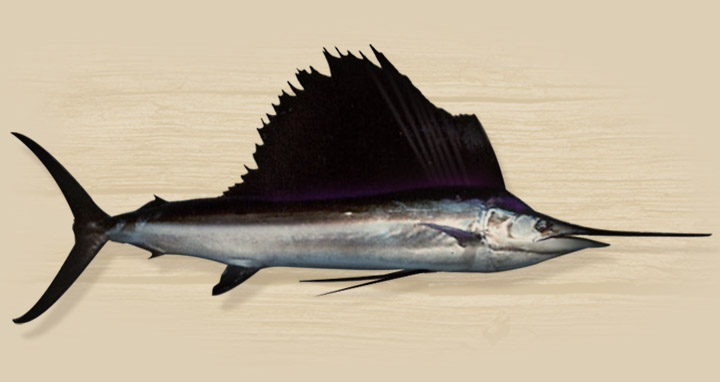
Sailfish(Istiophorus platypterus)
Quick Facts
- Other Names: Spindle-beaks
- Size Range: The Atlantic sail can reach weights over 100 pounds, but most commonly caught fish are 30 to 60 pounds.
- Native Species?: Yes
- Food Value: They are most commonly smoked, as their edibility is fair to poor. However, most anglers practice catch and release with billfish species.
State Record
- Louisiana State Record: 96lbs
- State Record Date: 10/1/1953
- State Record Holder John Lauricella
Sailfish have a dark blue to black back and are silvery to brown on the underside. The upper jaw forms an elongated bill. The dorsal fin is stretches the length of the back and resembles a sail. They have the most distinct fin of any of the billfish.
They are pelagic fish found in offshore waters, though the sailfish is commonly found in shallower and “greener” water than most other billfish.
Most anglers normally troll with natural baits and lures for sailfish or use live baits in some areas. Sailfish are a highly sought after prize for anglers and the focus of many tournaments in all over the world. When it comes to billfish, most anglers practice catch and release.
Sailfish Rules and Regulations
| Size Limit : | 63” min lower jaw fork length |
| Seasons : | Finfish |
All recreational anglers, including those not normally required to have a fishing license, and charter captains must obtain a Recreational Offshore Landing Permit to possess billfish.
A HMS Permit is required for all owners/ operator of vessels in the Gulf of Mexico fishing for and/or retaining the HMS regulated species of tunas, billfishes, swordfish and sharks. The Atlantic HMS Permits will be valid from the date of issuance through the end of the calendar year. The permit fee is $25.
An Atlantic HMS Charter/Headboat Permit is required for all charter or headboat fishing for and/or retaining regulated Atlantic HMS in federal waters of the Gulf of Mexico. The HMS Charter/Headboat Permit will be valid from the date of issuance through through the end of the calendar year. The permit fee is $20.
For information about contact the National Marine Fisheries Service (NMFS) Permitting Office at 1-888-872-8862 or 727-824-5399 or visit the NMFS Permit Shop at www.hmspermits.noaa.gov. For complete HMS regulations, contact the HMS Management Division at 301-713- 2347 or visit the website at www.nmfs.noaa.gov/sfa/hms/information.
There are Currently No Videos to Display
Related Fishing Methods
Fly Fishing
A style of fishing that utilizes a unique type of rods and reels. Long rods and simple reels allow for the presentation of “flies”, which are lures made of feather, fur, hair and synthetics. Different from conventional fishing, the weight of the line is used to carry the "lure" out whereas conventional methods use the weight of the lure to drag the line out. Flyfishing is said to be addictive and is growing in popularity.
Live Bait
Live bait is a term given to many different types of fish, crustaceans, insects and worms that are popular food items for fish and used by fishermen for bait. There are many benefits to live bait as well as a few cons. The pros normally out weigh the negatives, and live bait is widely used. The biggest benefit for fishermen is that they are using the real thing and often puts a fish's guard down. Small fish, crabs, shrimp, clams, crickets and the good ole earthworm are all used to entice a fish to the hook. The only negatives to live bait is just that, keeping it alive. Sometimes catching it can be a challenge, as only some species can be bought as live bait. No matter how you get it, live bait is a great way to target many types of fish.
Trolling
Trolling is the presentation of lure and/or baits from a moving boat. Many types of predatory fish are caught this way in both fresh and salt water. Speeds and presentations vary greatly depending on the target species. One may troll a small beetle spin for crappie with trolling motor in the lake, or charge around oil rigs at 15 knots with a high-speed wahoo spread. Trolling ballyhoo offshore is one of the most common, broad spectrum ways to catch all types of gamefish. Again there are many different methods to choose from.
Related Fishing Gear
Mono Ballyhoo Rig
A ballyhoo rigged on a mono-leader is used for fish without teeth. That list includes, dolphin, tuna and all of the billfish; blue and white marlin and sailfish. The strength of mono to use is determined by the size-class of the tackle you will be fishing, the target species and method.
