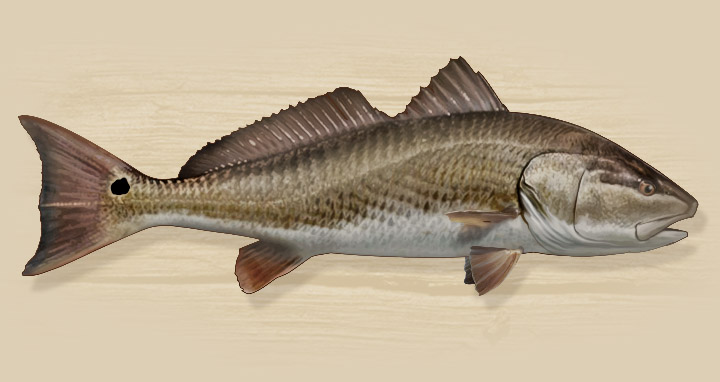
Red Drum(Sciaenops ocellatus)
Quick Facts
- Other Names: Redfish, Red Drum, Channel bass, Spottail bass
- Size Range: Redfish can reach weights over 90 pounds, but an average size is 4 to 30 pounds.
- Native Species?: Yes
- Food Value: Their edibility is excellent, and a blackened redfish recipe is known to have been a large part of their popularity. Once caught commercially, the redfish now enjoys a gamefish status.
State Record
- Louisiana State Record: 61lbs
- State Record Date: 6/1/1992
- State Record Holder David Weber
One of the most popular inshore Louisiana sport fish, the redfish is a robust, large scaled fish with a copper to bronze coloration, white belly and one or more distinct black spots, normally near the tail. They have a downward turned mouth with a few gripping teeth. They are closely related to the black drum.
Redfish are as versatile in their habitat as they are in their feeding. They are found along the southern Atlantic states and the Gulf of Mexico. Inshore grass flats, oyster reefs, tidal creek mouths and offshore structures are all good places to find redfish. Large schools of adult reds migrate offshore to spawn. This makes them easy to harvest in large numbers, which previously led to a decline in their population. Now a gamefish, they are carefully managed and their populations have rebounded.
The redfish is a versatile feeder, and anglers use many tactics to catch them. Fly fishing and conventional lures are popular, but redfish readily take live and dead bait, too. A tough fighter on appropriate tackle, the red must often be revived after a battle. They can be sight-fished in the shallows (on flats and oyster reefs) or caught near structures in shallow offshore waters.
Red Drum Rules and Regulations
| Size Limit : | Minimum of 16” and a maximum of 27” |
| Bag and Possession Limit : | 5 per person daily |
| Seasons : | No Closed Season |
| Special Rules : | Anglers can have one of the five fish limit over the 27 inch slot. |
Two days’ bag limit allowed in possession off of the water, not while fishing or in a boat.
Recreational saltwater anglers may possess a two day’s bag limit on land; however, no person shall be in possession of over the daily bag limit in any one day or while fishing or while on the water, unless that recreational saltwater angler is aboard a trawler engaged in commercial fishing for a consecutive period of longer than 25 hours.
Take or Possession of red drum in federal waters is prohibited.
How-To: Fish Spinnerbaits for Redfish
Mike Fernett of Redfish Lodge in Louisiana is head over heels about using spinnerbaits for redfish. Louisiana has some of the best inshore fishing in the ... Read More
How-To Tag Redfish & Trout
Louisiana has harnessed the power of numbers by encouraging the angling public to participate in a tagging program for vital species. These citizen scientists tag fish ... Read More
Fisheries Research Lab Facility
The Fisheries Research Lab took roughly ten years to plan and build but has greatly increased the scope of LDWF and its programs benefit every angler and ... Read More
Related Fishing Methods
Dead Bait
Dead bait consists of many different types of bait that is no longer alive. Dead bait is still attractive to many fish as they are normally feeding by smell and dead bait is the ticket for smell. Fresh cut fish, dead shrimp, half crab, shucked clam, cut squid and all popular examples of bait that will catch a wide variety of fish. Many sport fish that are predators, will gladly take the opportunity to slurp up a fresh dead bait. A redfish is equally happy to chase down a baitfish or slurp up a dead shrimp on the bottom. Dead bait has the benefit is being easy to obtain, maintain and transport, as opposed to live bait which takes livewells, quality water control and can be harder to obtain.
Fly Fishing
A style of fishing that utilizes a unique type of rods and reels. Long rods and simple reels allow for the presentation of “flies”, which are lures made of feather, fur, hair and synthetics. Different from conventional fishing, the weight of the line is used to carry the "lure" out whereas conventional methods use the weight of the lure to drag the line out. Flyfishing is said to be addictive and is growing in popularity.
Jigging
A versatile method of fishing for many types of fish in both freshwater and salt. A jig is a lure, normally a lead-headed lure with many various types of body/tail configurations made of rubber, hair and feather. Jigs are one of the most versatile of all lures and can be tipped with bait or not. Traditionally jigs are worked in variety of up and down motions, and can be fished throughout the entire water column, depending on the fishery. A modern form of jigs called metal jigs has taken hold and many varieties and shapes have been developed to work different ways. Made famous by the Shimano Butterfly Jig and now produced by many companies in many variations. If I could only have one lure to fish with it would be a jig.
Live Bait
Live bait is a term given to many different types of fish, crustaceans, insects and worms that are popular food items for fish and used by fishermen for bait. There are many benefits to live bait as well as a few cons. The pros normally out weigh the negatives, and live bait is widely used. The biggest benefit for fishermen is that they are using the real thing and often puts a fish's guard down. Small fish, crabs, shrimp, clams, crickets and the good ole earthworm are all used to entice a fish to the hook. The only negatives to live bait is just that, keeping it alive. Sometimes catching it can be a challenge, as only some species can be bought as live bait. No matter how you get it, live bait is a great way to target many types of fish.
Sight Fishing
The process of slowly searching the water and spotting fish, that you then present a bait too. Takes stealth and patience, but the visual reward is awesome. It is practiced on the flats for redfish as well as coastal areas for cobia and tripletail.
Topwater
Topwater fishing refers to the working of lures that are designed to float on the surface and twitch, splash and swim like a wounded prey. The visual aspect of the bite makes this a very popular way to fish. Most predatory fish will crash a topwater plug at one time or another. Early morning, evening times are traditionally better in freshwater and inshore saltwater fisheries. Offshore for pelagics like tuna, it is more about getting in range of feeding fish and working the lure in the zone. Hang on!
